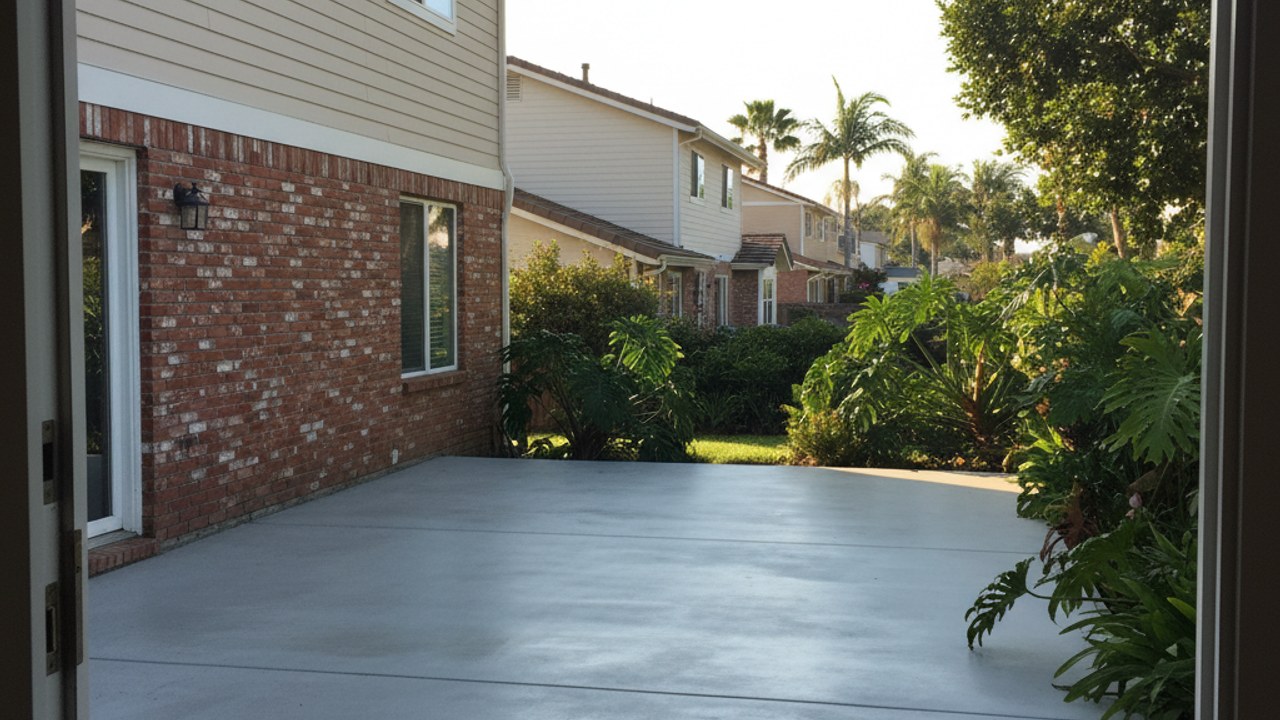
Most people shopping for concrete work compare two numbers: the total price and how soon the crew can start. Those matter, but they won't tell you whether the driveway is still flat in ten years or whether your patio is a spiderweb of cracks by year three. The questions below are the ones that actually separate a good pour from a bad one, and most contractors won't volunteer the answers unless you ask.
What's happening under the slab before any concrete shows up
Ask what the base prep looks like. This is the part nobody sees once the job's done, which is exactly why it gets skipped by contractors trying to save a day. A driveway or patio needs the topsoil stripped out, not just leveled over, because organic material under a slab breaks down and leaves a void. On top of that you want 4 to 6 inches of compacted gravel base, run over with a plate compactor, not just dumped and raked flat.
Shreveport and most of north Louisiana sit on clay soil, sometimes called gumbo clay locally. It swells when it's wet and shrinks hard when it dries out, and that movement is what pushes slabs up unevenly or opens gaps under a foundation. A contractor who knows the area will talk about this without being asked. If they don't mention soil at all, ask them directly what they do differently because of it.
What mix and what reinforcement, specifically
Not all concrete is the same concrete. Ask for the PSI rating of the mix, meaning how much compressive strength it's rated to hold. A standard residential driveway should be at least 3,500 PSI, and some contractors push to 4,000 for anything that'll see a lot of vehicle weight or freeze-thaw cycling. A patio or walkway can sometimes get by on 3,000, but there's no good reason to cheap out on a driveway.
Then ask what's reinforcing it. Wire mesh is common and cheaper, but it has a habit of sinking to the bottom of the pour if nobody pulls it up into position while the concrete's still wet, which means it ends up doing nothing. Rebar, typically half-inch steel on a grid, sits where it's tied and holds its position through the pour. For a driveway that'll take a truck's weight or a foundation slab, rebar is worth the extra cost. Ask which one they're using and why, not just whether reinforcement is included.
Thickness and how long before you can drive on it
Get the slab thickness in writing. Four inches is standard for driveways and patios. If someone's quoting you 3 inches to save on material, that's a corner being cut that you'll feel in five years when it starts to crack under a car's weight.
Ask how long before you can walk on it and how long before you can park on it. Concrete gains most of its strength in the first week, but it keeps curing for close to a month. Foot traffic is usually fine after 24 to 48 hours. Driving a car on it needs at least 7 days, and a lot of contractors will tell you to wait the full 28 days if you can, especially with anything heavier than a sedan. If a contractor tells you it's fine to park a truck on it the next day, that's worth questioning.
Who's cutting the control joints, and when
Concrete cracks. That's not a defect, it's physics, it shrinks as it cures and it has to crack somewhere. Control joints are cut into the slab on purpose so that the crack happens along a straight line you planned instead of wherever the concrete decides. These need to be cut within 24 hours of the pour, sometimes sooner in hot weather, because if you wait too long the slab has already cracked on its own terms.
Ask how far apart the joints will be. A rough rule is 2 to 3 times the slab thickness in feet, so a 4-inch slab usually gets joints every 8 to 12 feet. Ask whether they're sawcut or hand-tooled, and ask to see it done if you're around for the pour. If a contractor can't answer this without checking with someone else, that tells you something.
The paperwork that protects you if something goes wrong
Ask for the contract to spell out the thickness, the PSI, the reinforcement type, and the timeline in writing, not just a total price on an invoice. Ask what happens if it rains the day of the pour, since concrete poured into standing water or during a downpour has a weaker surface and can spall or scale within a couple of years. A contractor with any experience will already have a rain plan and won't pour into a flooded form just to keep the schedule.
Ask about the warranty on workmanship separate from the concrete supplier's material warranty, since those are two different things and cover different problems. Ask if they're licensed and insured, and ask to see proof rather than taking their word for it. If they're doing demolition of an old slab or driveway first, ask where the debris goes and whether that's included in the price or billed separately, since concrete removal is heavier and more expensive to haul than most people expect.
None of this is complicated, but it's easy to skip when you're just trying to get a price and a start date. Slow down on these questions before you sign anything. If you're in the Shreveport area and want someone to walk through your yard and tell you straight what the soil's going to do and what the job actually needs, that's the kind of conversation we have every day at Infinite Concrete Solutions.